
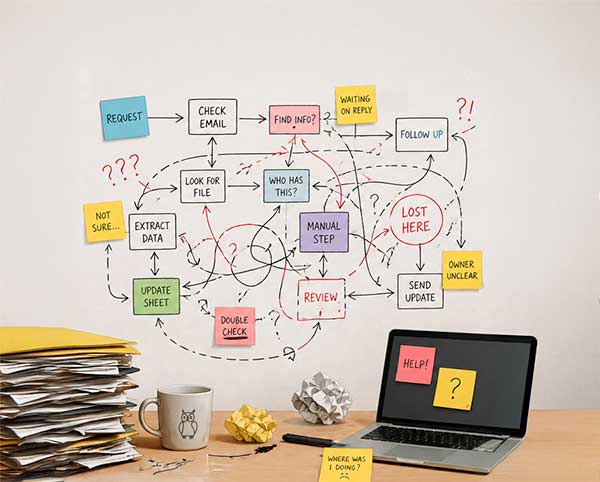
The easiest way to boost productivity? Tidy up your internal workflows
Most businesses do not realise this, but we see obstacle courses being built into their day‑to‑day work all the time.
A client update lands in one inbox, a note sits in someone’s app, a task is mentioned on a call, and the final document waits for three people to remember what happened. From the outside, nothing looks broken, but behind the scenes, the work is taking the long way round.
At Top Left Design, we know operational efficiency really starts with the everyday paths information takes through a business, and when those paths are messy, even great people and good technology end up moving slowly.
The real cost of tiny delays
Most teams don’t lose hours in one dramatic moment. They lose them in small pieces: hunting for notes, checking versions, chasing approvals, repeating updates, and turning spoken decisions into written records.
A workflow is simply the route a task follows from start to finish. When that route is clear, everyone knows what comes next. When it’s unclear, people make their own workarounds, and those workarounds usually create more admin.
For teams that rely on spoken updates, building voicetechnologies.co.uk into the capture stage can help speech become text, tasks, and records rather than another loose message waiting to be sorted.
The UK has been talking about productivity for years, and businesses are still under pressure to get more value from the time, tools, and people they already have. Any attempt to improve the UK’s long-running productivity problem has to look inside the business, not just at sales, hiring, or bigger software budgets.
Better workflows make technology useful
Buying another tool won’t fix a confusing process. In fact, it can make things worse if nobody knows where the work should be. Good technology supports a clear route: capture the information, send it to the right person, turn it into the right output, and store it where it can be found later.
That’s why voice-led workflows are becoming more valuable. People often explain work faster than they type it. A project lead can dictate a site update. A consultant can record client notes after a call. A legal, medical or finance team can capture sensitive details while they are still fresh.
A stronger workflow captures information at the source, sends work to the right person, makes progress visible and reduces repeated typing. It also keeps records easy to find and protects sensitive data, which matters when teams are handling client details, project notes, or commercially sensitive information.
Hybrid work made this more urgent
When everyone sat in the same room, weak workflows could hide behind quick desk chats. Hybrid work has changed that. If a decision only exists in a hallway conversation or a half-remembered call, someone remote will miss it.
That’s why flexible and hybrid working practices are now tied closely to performance. Teams need systems that carry the work clearly between people, locations, and devices. Otherwise, flexibility becomes another source of confusion.
Good internal workflows give hybrid teams a shared memory. They turn calls into notes, notes into tasks, and tasks into visible progress. People don’t have to guess where things stand because the system shows them.
Efficiency is really about flow
The best operational changes often feel almost boring once they are working. Fewer chasers. Fewer missing notes. Fewer “who has the latest version?” messages.
A business becomes more efficient when work moves cleanly from one step to the next, with less effort wasted in between. Start by fixing the routes your information takes, and the technology you already have may suddenly do more of the job it was bought for.


